Instacart debuts its new ChatGPT app – Digital Commerce 360
Get access to essential strategic content, in-depth reports, industry intelligence, and exclusive data.
Get access to essential strategic content, in-depth reports, industry intelligence, and exclusive data.
Get access to essential strategic content, in-depth reports, industry intelligence, and exclusive data.
Get access to essential strategic content, in-depth reports, industry intelligence, and exclusive data.
Sign Into Digital Commerce 360
Forgot your password?
Table of Contents
Table of Contents
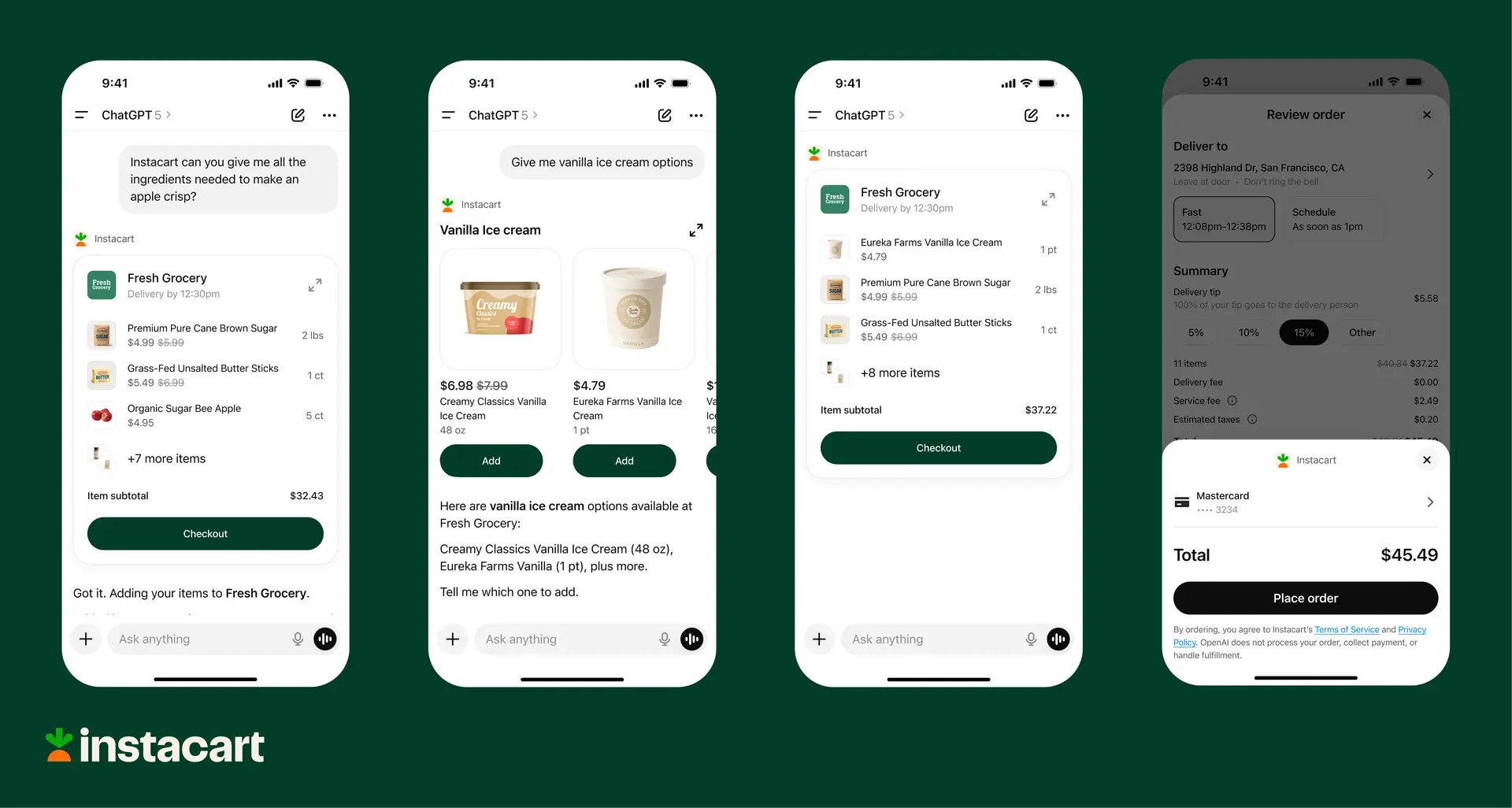
Instacart launched a new shopping app inside ChatGPT, bringing online grocery ordering directly into the artificial intelligence (AI) assistant.
Now live, the integration makes Instacart the first grocery partner — and the first app overall — to support end-to-end shopping with Instant Checkout inside OpenAI’s ChatGPT, according to dual announcements from the companies. In time for the holidays, shoppers can build grocery carts and complete checkout directly inside a chat, with orders fulfilled through Instacart’s own delivery network.
ChatGPT debuts new checkout experience for Etsy, Shopify merchants
More broadly, the app highlights how retailers are now using AI systems not just to surface products, but to carry out complete shopping tasks. The growing trend — often referred to as agentic shopping or “agentic commerce” — allows AI to take action on a user’s behalf, including completing entire purchases.
In practice, the Instacart experience starts with a prompt inside the chat interface. Shoppers can ask ChatGPT a question such as, “Instacart, can you help me shop for apple pie ingredients?” OpenAI said ChatGPT may also suggest the Instacart app when users mention food, recipes or meal ideas.
From there, shoppers can sign into their Instacart account to install the app. Once connected, the app pulls items from nearby retailers and assembles a ready-to-review cart using OpenAI’s models, the companies said.
Notably, the experience draws on Instacart’s real-time inventory and pricing data, so recommendations reflect what is actually available at local stores.
“Powering grocery shopping inside an AI agent requires technology that understands constantly changing, highly local inventory and converts it into accurate, real-time decisions,” stated Anirban Kundu, chief technology officer at Instacart, in the announcement.
The app also incorporates shoppers’ existing preferences — such as past orders and favorite brands — similar to how personalization works in Instacart’s own app and website. Once a cart is finalized, users can check out and pay directly within ChatGPT, without switching to a separate site or app, OpenAI said. Instacart then assigns a shopper to pick and deliver the order through its network, which now spans nearly 100,000 stores across North America.
Behind the scenes, the in-chat payment flow is enabled by OpenAI’s new Instant Checkout experience.
OpenAI introduced Instant Checkout earlier this year, initially with Etsy and a limited group of Shopify merchants. Since then, the company has announced additional commerce partnerships — including with Walmart and Target — as it works to expand in-chat shopping.
Instant Checkout runs on the Agentic Commerce Protocol, an open-source framework co-developed by OpenAI and Stripe. Payments are processed through Stripe, with Instacart support for digital wallets such as Apple Pay and Google Pay expected to roll out in the coming weeks.
According to OpenAI, Instant Checkout for Instacart is available to ChatGPT Pro, Plus and logged-in free users in the United States. The full Instacart experience with Instant Checkout is available on desktop and mobile web. The standalone Instacart app is available on iOS and Android, with Instant Checkout expected to launch on those native platforms in the coming weeks.
For Instacart, the ChatGPT app builds on a broader partnership with OpenAI. Instacart was an early contributor to OpenAI’s Operator research preview, according to the companies, and continues to use OpenAI APIs alongside its own AI technology.
Earlier this year, Instacart launched Smart Shop, which uses generative AI and machine learning to personalize food recommendations. In November, Instacart followed with additional AI tools for grocery retailers, including an agentic shopping assistant called Cart Assistant. Kroger is among the first retailers planning to offer Cart Assistant to customers.
Instacart said its partnerships with OpenAI, as well as Google and Microsoft, are “helping define how grocery shopping works across the next generation of digital agents.”
Looking ahead, the company added that it expects ‘every generative AI company to connect more directly with Instacart’s grocery engine, linking their massive consumer reach with our network of retail partners and driving incremental demand.”
The Instacart launch shows chat-based commerce moving closer to real transactions, with grocery emerging as an early proving ground for agentic shopping.
Early data suggests the shift is already underway. Adobe data indicates traffic from AI-driven sources to ecommerce sites rose 758% year over year between Nov. 1 and Dec. 1. The firm also projected that traffic from large language models (LLMs) to retail sites would increase 515% to 520% during the 2025 holiday season, compared with 2024.
Shopping activity inside ChatGPT is also increasing. Shopping has gained a larger share of mobile ChatGPT queries in recent months, according to Sensor Tower data cited by Bain & Company. From December 2024 through June 2025, shopping-related queries rose from 7.8% to 9.8% of all searches. This represents a 25% category gain on top of roughly 70% overall growth in ChatGPT usage, Bain said.
That growth effectively means shopping queries doubled over the six-month period from January to June. Bain noted that “optimizing for AI (AIO) — also called generative engine optimization (GEO) — with ChatGPT and Perplexity is no longer an option for B2B and consumer brands.”
Against that backdrop, OpenAI has continued to expand ChatGPT’s shopping capabilities. In November, the company rolled out new shopping research features that add personalized recommendations, feedback and discovery tools across its apps and subscription tiers. The updates position ChatGPT more directly against competitors such as Perplexity and Google, which are also expanding agentic shopping tools.
Submit your data and we’ll see where you fit in our next ranking update.
Stay on top of the latest developments in the online retail industry. Sign up for a complimentary subscription to Digital Commerce 360 Retail News. Follow us on LinkedIn, TikTok, X (formerly Twitter), Facebook and YouTube. Be the first to know when Digital Commerce 360 publishes news content.
More on This
In This Article
Companies
Industries
Topics
Related Stories
Kroger, Instacart expand partnership with agentic AI options
ChatGPT adds shopping research with holiday gift advice in mind
Best Buy and others add Uber Eats, Instacart for delivery options
Ecommerce Trends: How to understand agentic commerce levels currently in use
Instacart adds in-stock visibility features to please consumers, hoping to help retailers as well
Copyright © 2025 Digital Commerce 360 | Vertical Web Media LLC
Copyright © 2025 Digital Commerce 360 | Vertical Web Media LLC
