John Lewis tops AI's Christmas shopping recommendations as ChatGPT reshapes retail – PPC Land
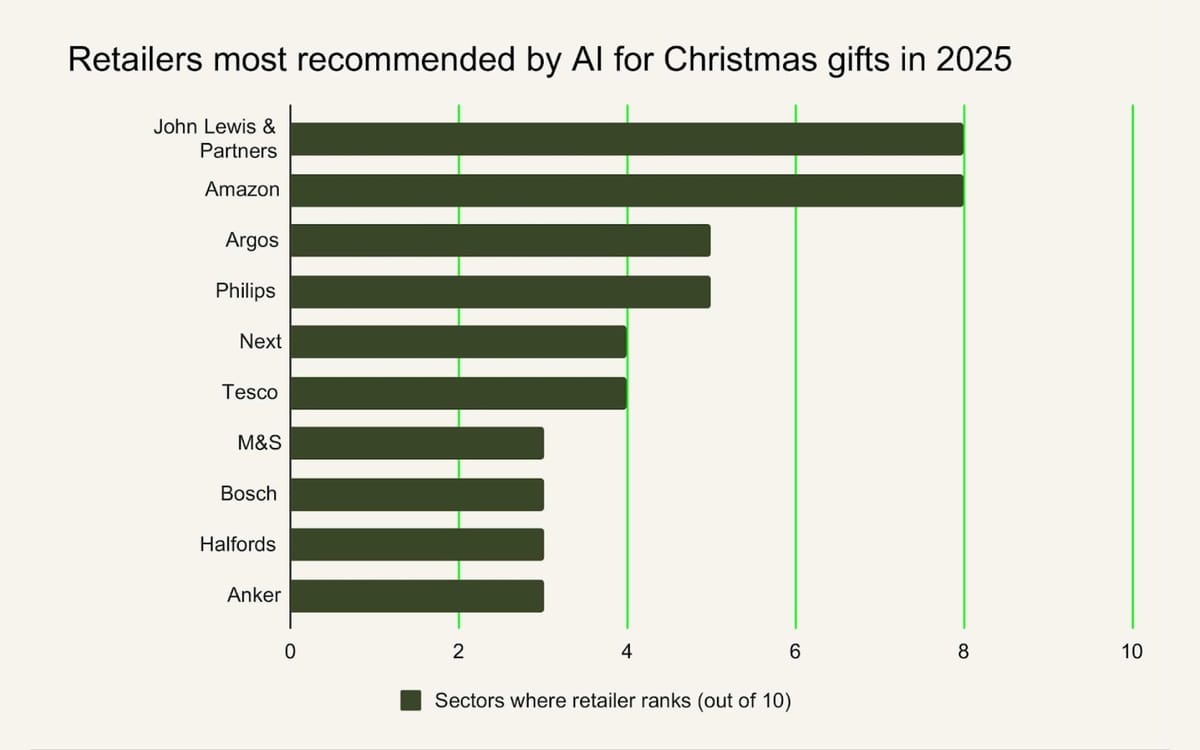
John Lewis achieved the highest visibility in ChatGPT's shopping recommendations this Christmas, outranking over 1,000 retailers as artificial intelligence transforms how consumers discover products.
Research published on December 17, 2025, by digital marketing agency Tank revealed which UK retailers appear most frequently when consumers ask ChatGPT for Christmas gift suggestions. The analysis examined hundreds of ChatGPT responses across 10 retail sectors, exposing how algorithmic recommendations could influence billions in holiday spending.
John Lewis secured 31 mentions across eight product categories, placing it ahead of Amazon’s 30 mentions. Multi-category retailers dominated the rankings, with Argos claiming third position with 10 mentions spanning five sectors. The findings arrive as ChatGPT processes over 1 billion weekly searches globally, positioning the platform as an emerging competitor to traditional search engines for product discovery.
“Shoppers want to maximise their time and budget to create the perfect Christmas,” said Karl McKeever, founder at Futurview Retail Consultants. “In the past, this meant spending hours on the high street, visiting multiple stores for inspiration and to check stock. Now they’re getting smarter, using online search and AI tools to remove the guesswork and drudge from festive shopping.”
The research comes as UK shoppers prepare to spend £91 billion this Christmas, with online sales alone projected to reach £34 billion. Nearly half of consumers—46 percent—expressed willingness to use AI agents for Christmas shopping assistance, including gift recommendations. Some shoppers indicated they would provide AI systems with budgets up to £200 to make autonomous purchasing decisions.
Subscribe PPC Land newsletter ✉️ for similar stories like this one
ChatGPT launched its shopping research feature recently, creating buyers’ guides from online sources and providing product recommendations with pricing information and purchase links. The platform describes results as “organic and unsponsored” based on relevance rather than advertising payments. In the United States, shoppers can complete purchases directly within ChatGPT using instant checkout functionality.
Tank’s methodology assigned mention scores based on how early retailers appeared in ChatGPT responses. First mentions received five points, while fifth-place mentions scored one point. The scoring system revealed which retailers secured the most valuable positioning within AI-generated recommendations.
Among fashion retailers, M&S achieved the highest mention score of 21 out of 138 websites analyzed. Next followed closely with a score of 20, while Barbour secured 17 points. The fashion sector’s prominence in AI recommendations reflects broader industry transformation, with Google introducing virtual dressing room capabilities earlier in 2025.
John Lewis maintained leading positions across multiple categories. The retailer topped recommendations for both food and drink and home goods, outperforming competitors including M&S, Habitat, Next, and even its partner brand Waitrose. The company’s annual Christmas advertisement generates substantial press coverage and social media conversation, potentially contributing to its algorithmic visibility.
Samsung dominated electronics recommendations with a mention score of 25, surpassing competitors Anker, Sony, and Amazon. Tech giant Apple ranked lower with a mention score of 10, despite predictions that the latest iPhone release would top Christmas wishlists. The disparity highlights how AI recommendation algorithms may prioritize different factors than traditional advertising or brand recognition alone.
Follow PPC Land on your socials: LinkedIn, Google, Google News, X, Mastodon, Bluesky, Reddit, Threads or via RSS
Charlotte Tilbury emerged as the top cosmetics recommendation with a mention score of 30, followed by Estee Lauder at 18. Clinique and Look Fantastic each scored 9 points. ChatGPT appears to link directly to brand websites rather than department stores or multi-brand retailers for beauty products.
Bosch achieved the highest mention score of 31 for home improvement products. Halfords led automotive and car care recommendations. Decathlon secured top positioning for sports products with a mention score of 15, ahead of Adidas, New Balance, and Nike, which each scored 11 points.
Amazon dominated books and entertainment with a mention score of 43, significantly ahead of eBay’s 23 points and Babbel’s 9 points. For toys, LEGO and Smyths Toys shared the highest mention score of 15.
Philips ranked fourth overall despite having fewer total mentions than some competitors. The electronics brand appeared across five sectors with eight total mentions, demonstrating cross-category visibility that Tank’s research identified as particularly valuable for multi-product manufacturers.
“ChatGPT is used everyday for personal and commercial queries such as Christmas gift ideas, so if brands aren’t appearing for the relevant results, they could be missing out on sales,” said Martin Harris, head of digital at Tank. “AI search is important for retailers and while there is hesitancy around it, it is essential brands are discoverable where shoppers are searching for information.”
The research methodology involved analyzing ChatGPT-4 search results for 200 general Christmas gifting prompts, including 20 sector-specific questions across 10 online retail sectors. Data was collected in November 2025, providing a snapshot of algorithmic recommendations during peak holiday shopping preparation.
Tank’s analysis revealed that ChatGPT mentioned over 1,000 retailers total, but household names and large e-commerce platforms achieved substantially higher visibility than smaller competitors. This concentration raises questions about whether smaller retailers can compete effectively in AI-mediated shopping environments.
Buy ads on PPC Land. PPC Land has standard and native ad formats via major DSPs and ad platforms like Google Ads. Via an auction CPM, you can reach industry professionals.
Small businesses anticipated a £5 billion Christmas boost in 2025, but the research suggests they may struggle to capture AI-driven traffic if larger retailers dominate algorithmic recommendations. The disparity could widen as more consumers adopt AI shopping tools for product discovery and purchasing decisions.
Tank’s experts outlined a five-part strategy for improving visibility in AI search results: search engine optimization, content creation, digital PR, brand PR, and social media presence. Each component addresses different aspects of how AI systems evaluate and select retailers for recommendations.
Jake Cassedy, SEO lead at Tank, explained that generative AI tools prioritize being cited as trusted sources rather than simply ranking for clicks. “Well-structured pages, smart internal linking and clear but natural language all help AI understand what your site is about and when to surface it in responses,” Cassedy said.
Content specialist Humairaa Habib emphasized the importance of answering customer questions directly. “ChatGPT says its shopping feature rankings are based on relevance, so your content needs to be as tailored as it can to your customers,” Habib said. “It helps if paragraphs are direct, answer the question immediately and include detail.”
Digital PR coverage emerged as a critical factor for AI visibility. James Watkins, head of digital PR at Tank, noted that high-quality links from reputable publications signal credibility to AI systems. “When you’re frequently mentioned or linked to by reputable publications, especially specialist or trusted media, it signals to AI systems that you’re credible, relevant and safe to surface in their responses,” Watkins said.
Brand PR contributes to long-term visibility through consistent cultural presence. Martyn Gettings, head of digital PR at Tank, pointed to John Lewis’s decades of Christmas-focused brand building as an example. “Retailers like John Lewis & Partners rank highly at this time of year because they’ve built decades of cultural capital around Christmas,” Gettings said.
Social media strategy requires balancing engagement-focused content with search-optimized material. Stuart Tongue, social lead at Tank, recommended allocating 70 percent of social efforts to traditional engagement tactics while dedicating 30 percent to SEO-based content answering frequently asked questions.
The technical infrastructure supporting ChatGPT’s shopping recommendations relies on Microsoft’s Bing Search API. Product selection operates through algorithmic methods incorporating structured metadata from third-party providers, consumer reviews, pricing information, and quality assessments from public reviews.
Retailers must avoid blocking OAI-SearchBot, ChatGPT’s web crawler, to receive consideration for shopping results. The crawler accesses publicly visible content through search result pages and websites directly, without API integrations to internal retailer databases.
ChatGPT’s approach differs fundamentally from advertising-based search models. The platform generates product recommendations based on user intent and preferences rather than paid placements. This methodology creates different optimization requirements than traditional search engine marketing.
OpenAI introduced shopping capabilities to ChatGPT on April 28, 2025, rolling out features to Plus, Pro, Free, and logged-out users globally. The shopping functionality activates when ChatGPT detects shopping intent in queries, displaying products in “visually rich carousels” with detailed information and purchase links.
The system employs sophisticated query rewriting to transform natural language into structured search parameters. When users express shopping intent conversationally, ChatGPT reformulates queries to target specific product attributes, categories, and price ranges. This translation process bridges conversational language and the structured data required for effective product retrieval.
Location data enhances recommendation relevance. ChatGPT collects general location information from IP addresses and shares that data with search providers to improve result accuracy. This geotargeting enables region-specific product availability and pricing information.
Product information flows through dual sources. Primary data derives from live web searches, while secondary information comes from ChatGPT’s training data. The system categorizes retrieved results through internal labeling, distinguishing between product listings with structured pricing data, web content including buying guides, and editorial reviews from news sources.
Follow PPC Land on your socials: LinkedIn, Google, Google News, X, Mastodon, Bluesky, Reddit, Threads or via RSS
The platform reached 700 million weekly active users in August 2025, representing a fourfold increase from the previous year. ChatGPT shopping features expanded to German users in July 2025, with the platform processing over 1 billion weekly searches globally.
OpenAI launched instant checkout capabilities on September 29, 2025, through the Agentic Commerce Protocol developed with Stripe. The functionality enables transactions from Etsy and Shopify merchants directly through ChatGPT conversations, with payment processing flowing through Stripe while merchants maintain fulfillment and customer service responsibilities.
The autonomous purchasing capability faces skepticism from industry analysts. Research examining consumer shopping patterns identified structural challenges including retailer incentives against AI intermediation, contextual factors influencing purchase decisions that shoppers may not consciously recognize, and consumer preferences for evaluating multiple options before committing to purchases.
Amazon has blocked AI bots from major technology companies including OpenAI, Meta, Google, and Huawei through robots.txt configurations. The e-commerce platform simultaneously develops proprietary AI shopping features including Rufus, which reached 250 million users in 2025, and the Help Me Decide recommendation system.
Google launched agentic checkout on November 13, 2025, enabling automated purchases through price tracking and Google Pay integration. The deployment coincides with market projections showing agentic AI potentially reaching $1 trillion valuation by 2035-2040, though commercial viability remains contested.
Consumer adoption of AI shopping assistance has accelerated heading into the 2025 holiday season. Research from PSE Consulting conducted between November 13 and November 17, 2025, found that 49 percent of UK adults use AI tools regularly, with 22 percent planning AI-assisted Black Friday and Christmas shopping.
Among consumers planning to use AI for holiday shopping, 85 percent indicated they would trust autonomous agents to place orders and execute payments on their behalf. The trust levels suggest growing comfort with delegating purchase decisions to algorithmic systems, though privacy concerns, fraud risks, and accuracy worries remain significant barriers.
McKinsey research published in November 2025 projects that agentic commerce could orchestrate between $900 billion and $1 trillion in US B2C retail revenue by 2030. Global projections reach $3 trillion to $5 trillion as AI agents acting autonomously on behalf of consumers reshape traditional e-commerce relationships.
The convergence of mature AI capabilities, extensive internet connectivity encompassing 5.6 billion users representing 68 percent of global population, and standardized payment protocols enables AI agents to execute complex shopping tasks. Systems designed for human-paced transactions now face pressure to support high-frequency, autonomous agent-initiated flows.
Marketing professionals must adapt strategies to address AI-mediated customer relationships. The shift affects advertising approaches, revenue models, and fundamental assumptions about how consumers discover and evaluate products. Brands visible in AI recommendations gain advantages in customer acquisition, while those absent from algorithmic results risk losing market share.
The competitive landscape for AI shopping visibility differs substantially from traditional search engine optimization. Rather than optimizing for click-through rates and page rankings, retailers must focus on establishing credibility signals that AI systems recognize as indicators of trustworthiness and relevance.
Technical requirements extend beyond website optimization to encompass brand presence across multiple platforms. Reddit citations in ChatGPT responses have increased, while Wikipedia and YouTube also appear frequently in AI-generated results. This distributed visibility requires coordinated strategies spanning owned websites, third-party platforms, and editorial coverage.
The retail industry faces fundamental transformation as AI systems increasingly mediate shopping decisions. Household names like John Lewis, Amazon, and Argos currently dominate algorithmic recommendations, but the ranking factors determining visibility remain partially opaque. Understanding how AI systems evaluate and select retailers represents a competitive advantage as consumer adoption accelerates.
Tank emphasized that retailers implementing generative engine optimization strategies position themselves advantageously for 2026 and beyond. As AI platforms introduce new features like in-app shopping, algorithmic visibility could transition from influencing buyer behavior to becoming a direct sales channel comparable to traditional e-commerce platforms.
The 2025 Christmas season serves as a test case for AI-powered retail. Retailers balancing efficiency gains from AI with emotional and personal elements that make holiday shopping meaningful may gain advantages in customer loyalty and revenue. The extent to which algorithmic recommendations reshape consumer behavior during peak shopping periods will indicate whether AI platforms fundamentally alter retail dynamics or merely supplement existing discovery channels.
Subscribe PPC Land newsletter ✉️ for similar stories like this one
Subscribe PPC Land newsletter ✉️ for similar stories like this one
Who: Digital marketing agency Tank conducted research analyzing ChatGPT-4 shopping recommendations. John Lewis & Partners achieved highest visibility with 31 mentions, followed by Amazon with 30 mentions and Argos with 10 mentions. Karl McKeever, founder at Futurview Retail Consultants, and Martin Harris, head of digital at Tank, provided industry commentary. Research examined over 1,000 retailers across fashion, electronics, cosmetics, home goods, sports, toys, books, entertainment, automotive, and home improvement sectors.
What: Tank analyzed hundreds of ChatGPT responses to 200 Christmas gifting prompts across 10 retail sectors, assigning mention scores based on recommendation positioning. John Lewis dominated food and drink, home goods categories while M&S led fashion with mention score of 21. Samsung topped electronics (25 points), Charlotte Tilbury led cosmetics (30 points), Bosch ranked first for home improvement (31 points), and Amazon dominated books and entertainment (43 points). Research methodology assigned five points for first mentions, decreasing to one point for fifth mentions. Data collected November 2025.
When: Research published December 17, 2025, with data collected November 2025. ChatGPT launched shopping research feature in 2025, now processing over 1 billion weekly searches globally. UK shoppers preparing to spend £91 billion this Christmas, with £34 billion in online sales projected. Nearly 46 percent of consumers willing to use AI agents for Christmas shopping, with some providing budgets up to £200. OpenAI introduced shopping capabilities April 28, 2025, expanded to German users July 2, 2025, and launched instant checkout September 29, 2025.
Where: Research focused on UK retailers and ChatGPT recommendations for British consumers. ChatGPT shopping features available globally across Plus, Pro, Free, and logged-out users. Instant checkout functionality currently limited to United States with Stripe integration. Platform reached 700 million weekly active users August 2025. Small businesses anticipated £5 billion Christmas boost. Research published by Tank, digital marketing and PR agency with offices in Nottingham and Manchester.
Why: Research matters as AI systems increasingly mediate shopping decisions, potentially influencing billions in holiday spending. ChatGPT’s 1 billion weekly searches position platform as emerging competitor to traditional search engines for product discovery. Brands absent from AI recommendations risk losing market share as consumer adoption accelerates. McKinsey projects agentic commerce could orchestrate $900 billion to $1 trillion in US B2C retail by 2030, with global projections reaching $3 trillion to $5 trillion. Marketing professionals must adapt strategies for AI-mediated customer relationships, requiring focus on credibility signals, content optimization, digital PR, brand visibility, and social media presence.
