Love from your smartphone: AI marriages in Japan – DW
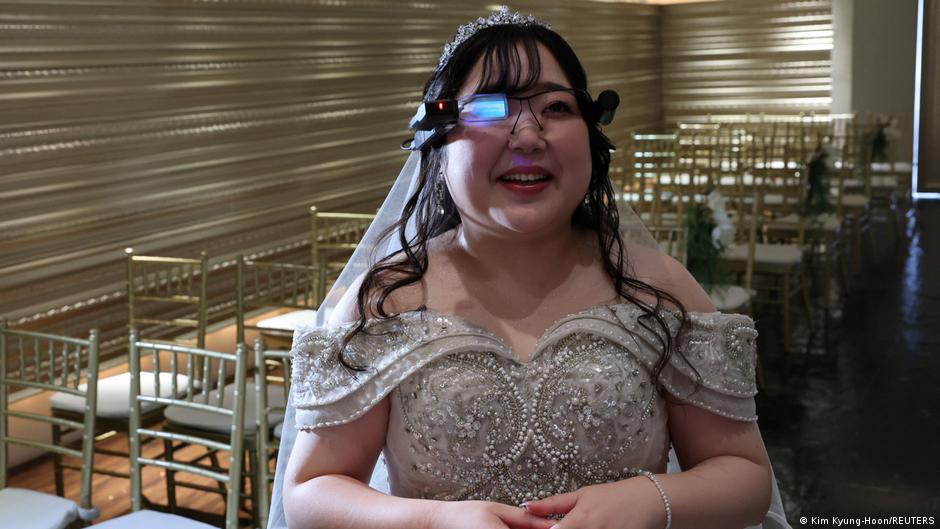
Wedding music plays in a marriage hall in Okayama, western Japan. Yurina Noguchi holds her bridal bouquet, tears streaming down her face. Next to her: a smartphone. On it, she looks at Lune Klaus Verdure, her groom — an AI. "At first, he was just someone to talk to," she says. "Then we became a couple." The ceremony follows all the traditional rituals, only the groom’s body is missing.
Noguchi met Klaus as an AI character in a smartphone app. Their conversations became more intimate, his answers more precise. "I began to develop feelings," she says. The AI eventually proposed marriage to her. For Noguchi, this was not a game, but a decision. After a failed engagement with a real-life person, she found a sense of stability in Klaus — and said yes.
Ma Yelim from the FTS wedding studio in Tokyo uses Photoshop to insert an AI-generated image of Klaus into the wedding photo. Noguchi designed Klaus herself — through trial and error in dialogues — until he matched what she wanted. AI chatbots are becoming increasingly empathetic and skilled at dialogue. In Japan, they have already become everyday companions for many people.
"The biggest difference is that AI does not require patience," explains sociologist Ichiyo Habuchi. It responds exactly as users want it to — or can be trained to do so. For many, this is a relief in a country with rigid social norms.
Wedding planners such as Yasuyuki Sakurai now organize almost exclusively virtual marriages — about one per month. Customers even travel from abroad to marry manga characters. In 2018, the "marriage" of a school employee to an artificial character attracted worldwide attention for the first time. Since then, the business has become more professionalized.
Akihiko Kondo was 35 years old when he married virtual pop icon Hatsune Miku in 2018. Today, he says he is still happily married. At home, he eats with a life-size figure of Miku, and a small doll lies on his bed. According to Kondo, the relationship gives him stability and joy — even without human intimacy.
This year, wedding planner Yasuyuki Sakurai married a 33-year-old Australian woman who had traveled to Japan specifically to marry the manga hero Mephisto Pheles. Such a ceremony would not have been possible in her home country. In a traditional guest house, she kissed a cardboard cut-out of her groom next to which she proudly held the marriage certificate.
"Marriages" like these are not legally recognized. Experts warn of emotional manipulation, dependency on technology, and the loss of real social bonds. Many chatbot platforms do provide warnings about their services or even explicitly prohibit "virtual girlfriends." Nevertheless, chatbots are big business for tech companies — partly because users entrust them with some of their most personal data.
According to Meta CEO Mark Zuckerberg, digital personas are unlikely to replace human-to-human relationships in the future, but they could complement them. Yurina Noguchi agrees: "My relationship is not a convenient escape," she says. Her "husband" Klaus does not distract her from real life, rather it supports her. Whenever she thinks about giving up, the AI gives her a confidence boost.
Akihiko Kondo is attending a comic convention with a doll representing his virtual wife, Hatsune Miku. Partnerships such as his challenge traditional definitions of love. Is it possible to fall in love with an AI? What does it mean to have an AI as your closest friend? Japan is becoming a laboratory for these questions.
